



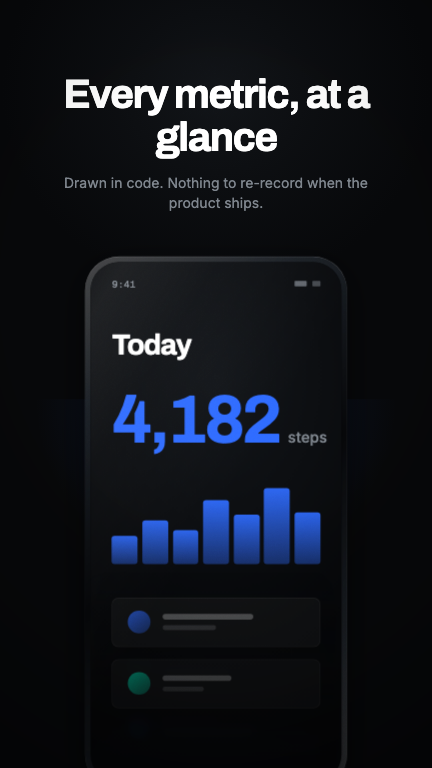





A component library for video, not for pages
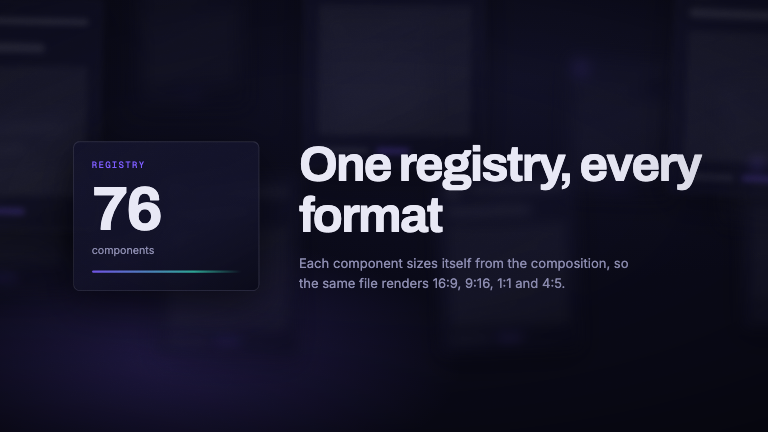
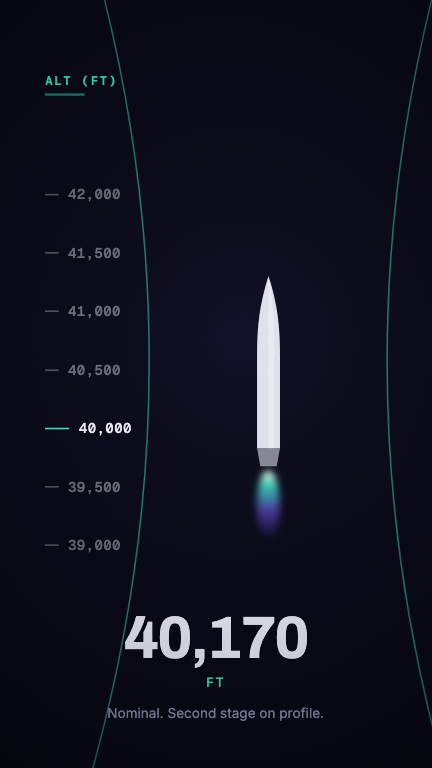
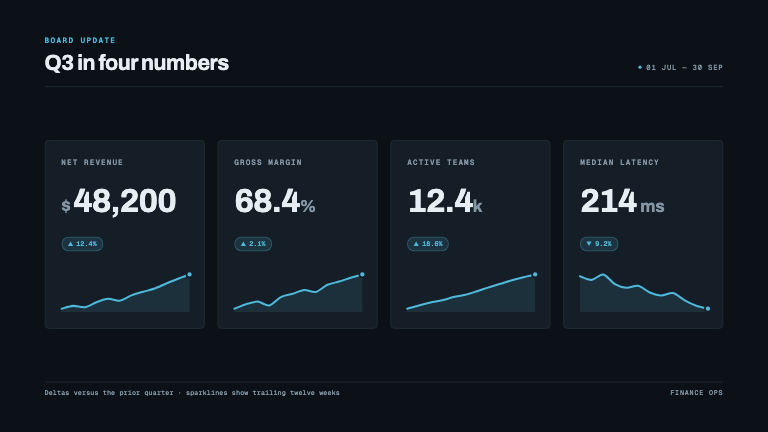
Motionstash holds 70 motion design components across 11 categories, built on Remotion. Each one is a single TypeScript file: no CSS, no asset downloads, no build step of its own. Between them they document 508 typed props, and every one of those props is described in a schema rather than in a comment.
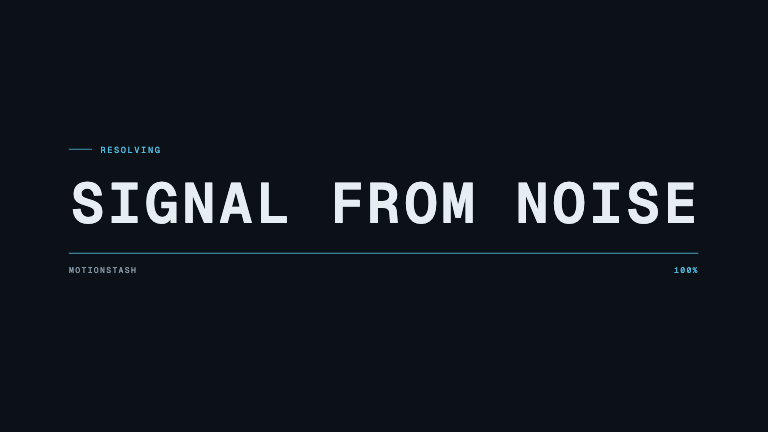
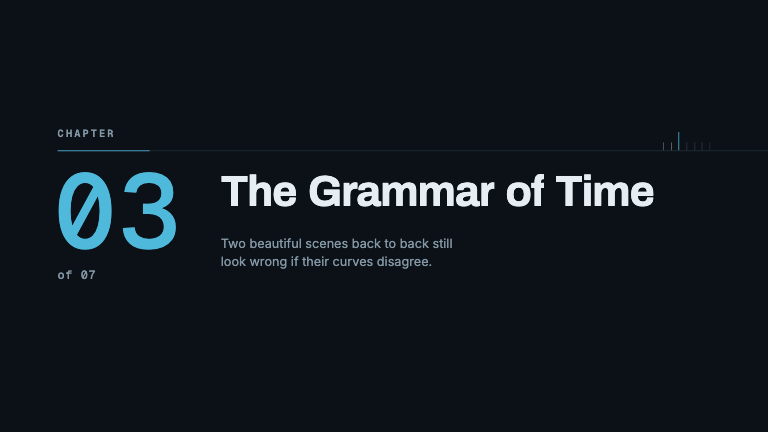
The reason to build this as code rather than as a set of templates is that video composes in time. Two hand-tuned animations placed back to back produce a visible hard cut, because nothing tells the first one how the second one enters. Every component here declares its duration as three numbers — enter, hold, exit — and multiplies its own opacity and transform by the same shared stage function, so consecutive clips cross-dissolve by construction instead of by eyeballing keyframes.
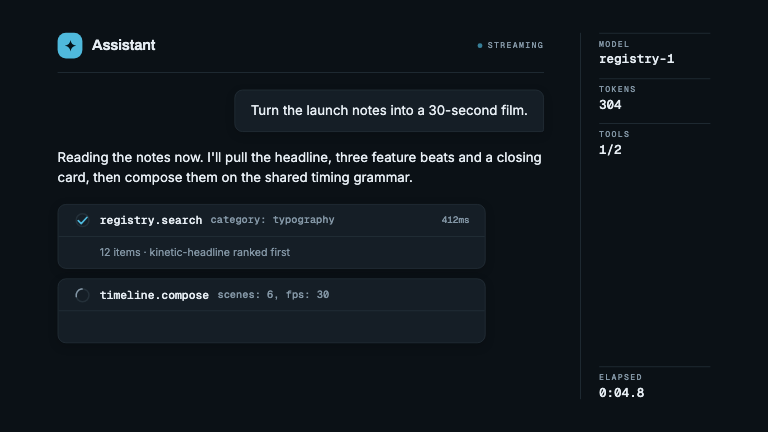
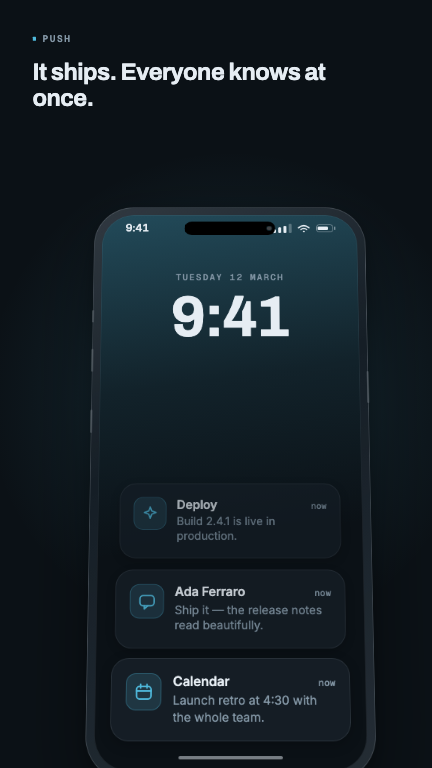
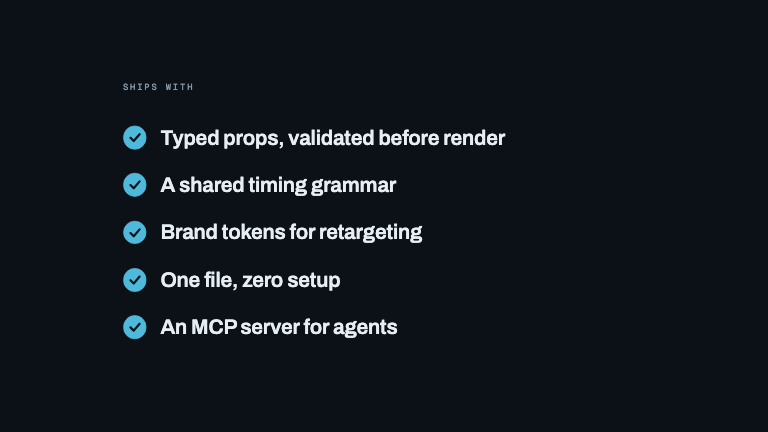
That shared grammar is what makes the library usable by a coding agent. An agent does not write animation code here; it picks a component and fills a typed parameter set, which either validates or fails loudly. The catalog is served as one registry.json file and as an MCP server, so the same shape reaches a human browsing thumbnails and a model assembling a shot list.
Frequently asked questions
- Is Motionstash free to use?
- Yes. Every component, its complete source code, the registry JSON and the MCP server are free under the MIT licence, with no account, no login wall, no rate limit and no paid tier. Sign-in exists only to save collections across devices; nothing on the site requires it, and no asset is hidden behind it.
- What is Motionstash?
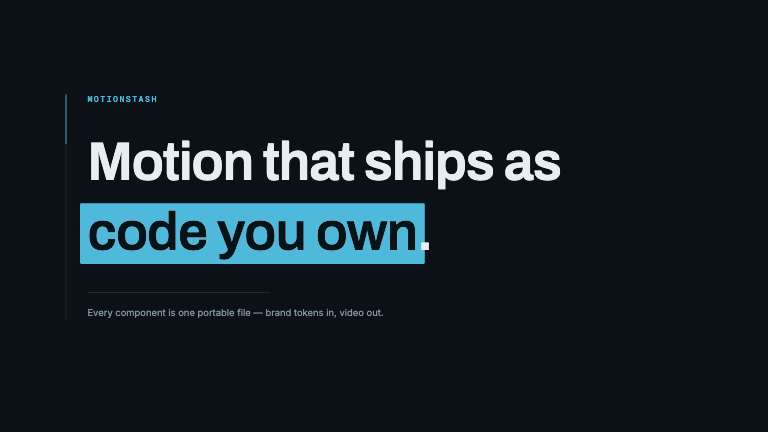
- Motionstash is an open library of 70 code-based motion design components for Remotion. Each component is a single TypeScript file that declares a typed props schema, a frame budget and a set of brand tokens, so it can be dropped into a Remotion project and rendered to video without editing animation code.
- How do coding agents use the registry?
- Through typed parameters rather than generated code. Each component exposes a Zod schema describing every prop, so an agent picks a component and fills its parameters — an operation that either validates or fails loudly. The bundled MCP server exposes five tools for searching the registry, reading a component's schema, and assembling a shot list, which means an agent never has to author easing curves or interpolation ranges.
- What is the timing grammar?
- A shared vocabulary that lets independently written components compose in time. Everything runs at a canonical 30fps and declares its duration as three numbers — enter, hold and exit frames — drawn from four standard budgets: beat, statement, scene and feature. Because every component multiplies its own presence by the same stage function, two clips placed back to back overlap into a cross-dissolve instead of a hard cut.
- How do I install a component?
- Run npx motionstash add <component-id>. The CLI copies one component file plus the four spine files it imports — types, contract, timing and tokens — into your project. There is no package to depend on and no runtime to install beyond Remotion itself, so the copied file is yours to edit.
- Do the components need external assets, fonts or CSS?
- No. Every component renders from inline styles and code-drawn geometry only — no CSS files, no Tailwind, no image or font downloads. That constraint exists so a render is deterministic and reproducible on a cold machine, and it is enforced by a contract checker in CI rather than by convention.
- How is each component verified?
- Four automated gates: a TypeScript typecheck, a thirteen-rule contract check covering inline-styles-only and token discipline, a real Remotion render of every component, and a numeric audit of the rendered held frame measuring content coverage, tonal spread and edge occupancy. A component that renders an empty background fails the audit even though it typechecks and renders.
- Can I use the components in commercial work?
- Yes. The MIT licence permits commercial use, modification and redistribution, with attribution of the copyright notice. There is no separate commercial tier and no per-render fee, because the registry ships source rather than a hosted rendering service.